Singapore shoppers and diners often see two public health labels: the Healthier Choice Symbol on packaged foods, and Nutri-Grade marks on drinks. They are useful shortcuts, but they answer different questions.This guide explains how to use both labels as part of an everyday food choice. It is general education, not personalised medical or dietary advice.
What the Healthier Choice Symbol means
Source: Health Promotion Board, Singapore. Shown only as an official reference
The Health Promotion Board states that the Healthier Choice Symbol identifies packaged food products that are healthier options within their respective food categories. That comparison matters: a product carrying the symbol is not automatically suitable for every person, every meal or an unlimited portion.You may see the symbol on products across categories such as beverages, breakfast cereals, sauces and convenience meals. Use it as a quick first filter, then consider the product, portion and rest of your meal.
What Nutri-Grade means for drinks
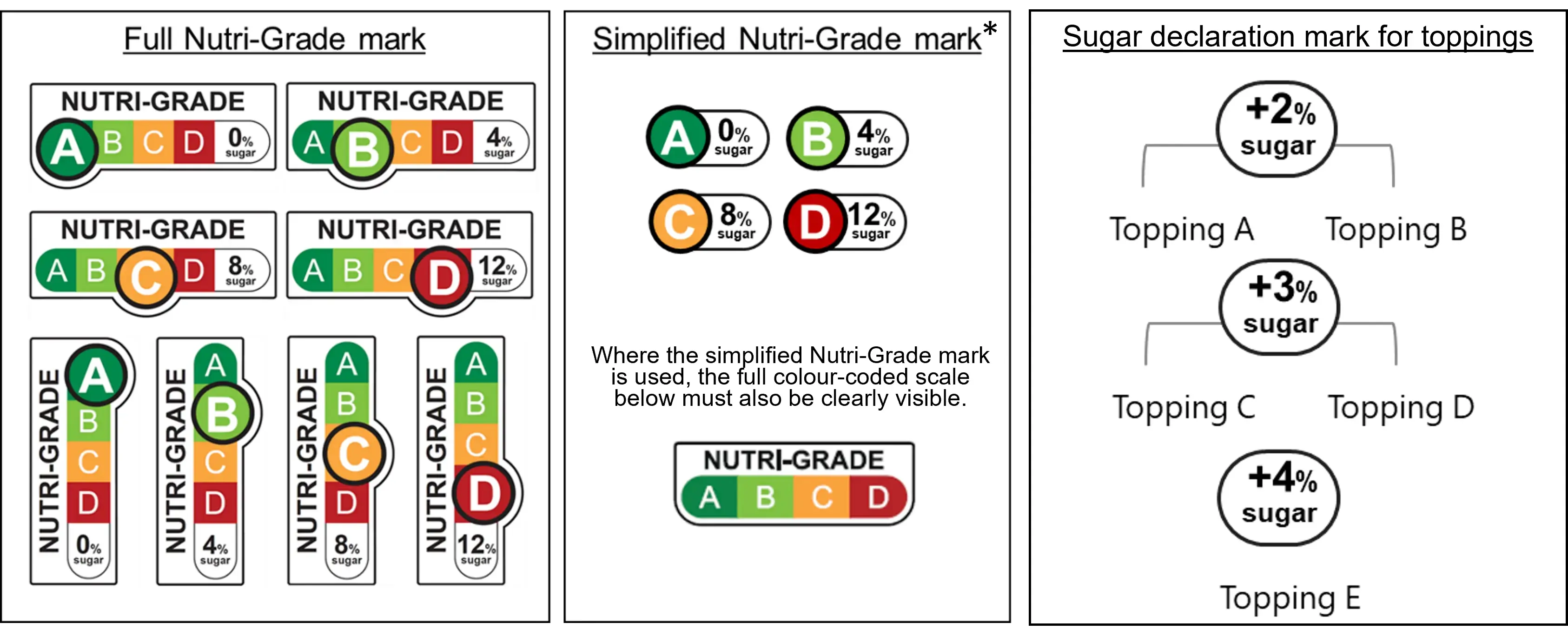
Source: Health Promotion Board, Singapore. Shown only as an official reference
Nutri-Grade grades beverages from A to D according to sugar and saturated fat thresholds. Grade A represents the lowest thresholds and Grade D the highest. The sugar percentage is also shown on the mark.In Singapore, drinks graded C or D must display the Nutri-Grade mark. Display for A and B drinks is optional, so the absence of an A or B mark does not automatically mean that a drink has a poorer grade.
Where you may see Nutri-Grade
The mark can appear on packaged drinks and beside freshly prepared drinks on menus or menu boards. This includes familiar choices such as kopi, teh, juices, smoothies and bubble tea. Toppings may carry a separate sugar declaration because they can change the drink’s total sugar content.
How to compare drinks in real life
Compare similar drinks rather than assuming one grade describes the whole meal.
Use water as a simple everyday default when it suits the occasion.
When choosing kopi or teh, consider less sugar or no added sugar options.
Remember that milk, creamer and toppings may affect sugar or saturated fat.
Look at portion size as well as the grade.
Use labels as guides, not verdicts
Food labels help reduce guesswork, but they do not replace the bigger picture. A balanced pattern still includes vegetables and fruit, suitable protein foods, staple foods, variety and portions that fit your needs.If you have diabetes, high cholesterol, kidney disease, food allergies or another medical concern, discuss individual choices with an appropriately qualified healthcare professional.
A simple supermarket and kopitiam checklist
Look for the Healthier Choice Symbol when comparing packaged foods in the same category.
Check Nutri-Grade when comparing drinks, especially C and D options.
Read the nutrition information when you need more detail.
Choose a portion and frequency that fit your overall eating pattern.
Keep enjoyment and practicality in the decision.
Frequently asked questions
Does Nutri-Grade A mean a drink has no sugar?
Not necessarily. Nutri-Grade is based on defined sugar and saturated fat thresholds. Check the label and nutrition information for the particular product.
Why do some drinks not show an A or B mark?
HPB states that Nutri-Grade labelling is optional for A and B drinks, while C and D drinks must display the mark.
Does the Healthier Choice Symbol mean I can eat as much as I want?
No. It helps identify a healthier option within a food category. Portion, frequency, your complete meal and individual needs still matter.Continue with our healthier eating-out guide, explore more Nutrition Guides, or return to the CLITE Journal.
THE LIGHT FINISH
Where would you like to go next?
Keep one practical idea from this guide, then continue when it suits you.

 Source: Health Promotion Board, Singapore. Shown only as an official reference